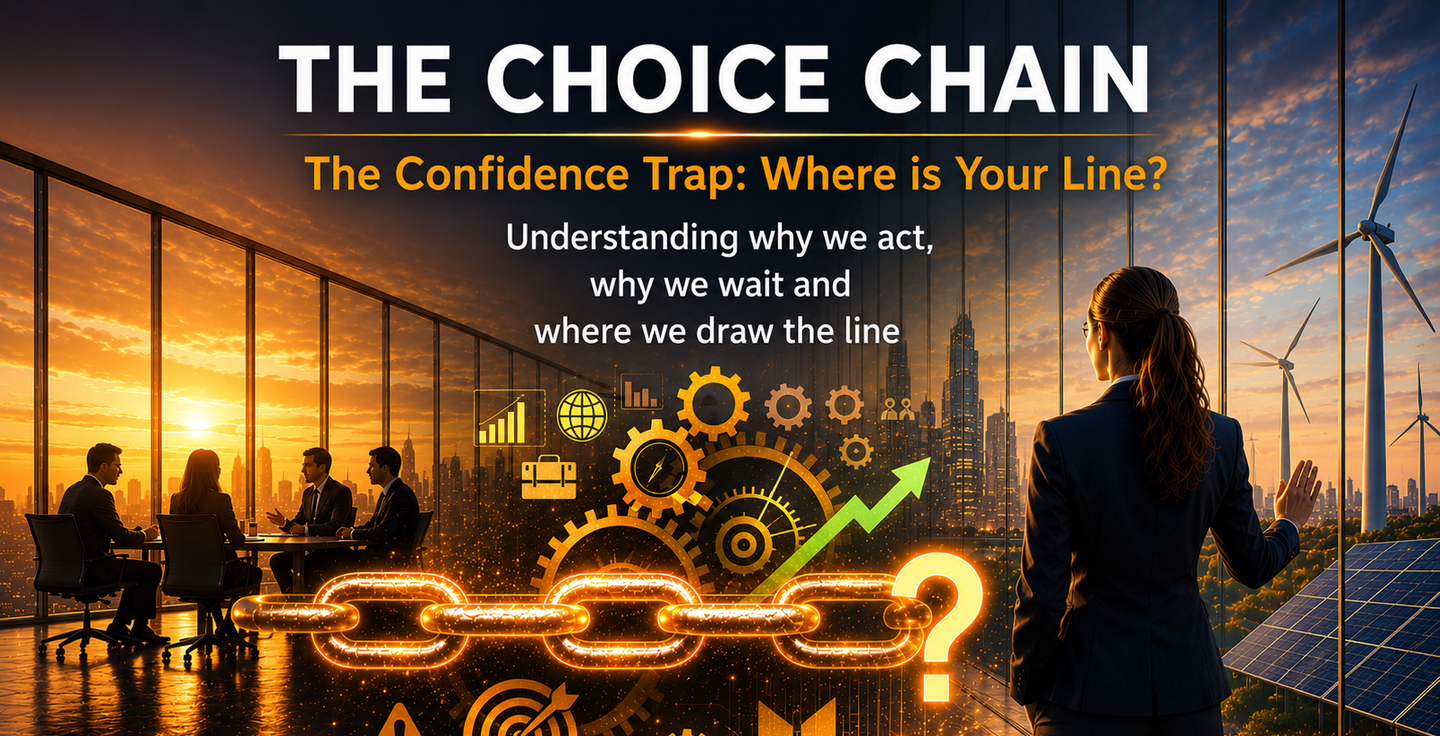
The Confidence Trap: Where Is Your Line?
The point where waiting stops being reasonable.
Over my career I have made very many decisions which have potentially changed the trajectory of the organisations I have served. During the pandemic I was starkly reminded that decisions often carry consequences far beyond the meeting room in which they are made.
Upon reflection, I have always had a very personal, professional and invisible line.
It isn't written down. It isn't defined by legislation, governance frameworks or corporate policies. In fact, it can be difficult to describe.
But I know when I am approaching it.
It is the point where uncertainty stops feeling like a reason to wait and starts feeling like a reason to act.
When I was a very newly qualified Environmental Health Officer, in Cambridge, I remember undertaking an inspection of a pub. I didn't know exactly what the technical issues were, but I had an instinct from what I was seeing that there were electrical issues beyond my current capabilities. A further visit with an electrical engineer confirmed significant, hidden electrical problems which could have led to the metallic bar becoming live. He looked directly at me and said, "you have good instincts, always follow them" — it's something I have always taken with me when I get a "spider sense" something is not quite right.
My line was probably defined in my early career as a regulator.
The more I reflect, the more I realised that most experienced leaders have a personal line.
The challenge is that we rarely talk about it.
We hear calls for stronger leadership, better governance or improved culture when things go wrong. We also have conversations about organisational risk appetite. Yet many major failures did not occur because information was unavailable. The signals were often present long before the consequences became visible.
Climate change. Public health. Corporate scandals. Safety failures. Financial crises.
In many cases, people knew enough to be concerned.
The question was whether they knew enough to act.
I have come to believe that one of the biggest risks facing organisations today is not a lack of information. It is the belief that there is still time.
- Time for another report.
- Time for another review.
- Time for more evidence.
- Time for the issue to become clearer.
- Time for an alternative perspective.
Sometimes that is the right decision. Often it is not.
Waiting is rarely a neutral act. Waiting is a choice in itself.
One of the reasons I think this happens is that consequences often feel distant and abstract. We struggle to connect today's decisions with tomorrow's outcomes. We convince ourselves that because a consequence has not yet materialised, it is not yet important.
The further we are from decisions as the customer, the worker, the community affected, or indeed the Environmental Health and Safety professional, the easier it becomes to discuss risk intellectually rather than as a personal experience.
History suggests otherwise.
A series of seemingly rational choices can quietly create the conditions for failure long before anyone recognises where the chain is leading.
We often discuss organisational risk appetite as though it belongs to the organisation itself. Yet organisations do not feel consequences. People do.
Boards, executives and managers bring their own experiences, values and thresholds into every decision. These individual lines are then combined, challenged and negotiated through governance processes.
Perhaps that is why risk appetite can sometimes feel so difficult to define. It is not simply a statement. It is the collective expression of where people believe action becomes necessary.
What I have learned is that my personal, professional invisible line moves.
In organisations where challenge is welcomed, difficult conversations are heard and action follows insight, my line sits further away. This isn't because I believe the organisation is infallible, but because I trust its ability to recognise problems, challenge assumptions and adapt. In fact, I have sat with CEOs who have contradicted my perspective and when I am confident their decisions are grounded in understanding, this gives me confidence rather than concern.
In organisations where important signals are repeatedly delayed, diluted or explained away, this line shifts closer. Long discussions without decisions. Repeated requests for more evidence. The same issues resurfacing without resolution. These are often the moments when my instinct tells me the risk may not be the issue. The organisation's ability to respond to it may be.
So my concern is not the issue, but the growing gap between awareness and action. The risk itself may not have changed. My personal, professional confidence in the organisation's ability to respond has.
Perhaps that is why the recent discussions around AI have been so fascinating. We now have access to more information, more analysis and more intelligence than ever before. Yet the challenge remains deeply human.
- How much information is enough?
- When do we know enough to act?
- What happens when certainty never arrives?
For me, leadership is not about having all the answers. Stewardship is not about eliminating uncertainty.
It is about recognising the moment when we know enough that doing nothing no longer feels like a responsible option.
For me, this is where professional judgement and personal integrity meet.
This is the point where I can no longer separate what I know from what I feel responsible for.
Organisations do not make decisions, people do. Risk appetite statements do not make decisions, boards and executives do.
Each consequential decision eventually becomes personal. Not because certainty has arrived but because someone chooses to act.
What issue keeps resurfacing?
- The one that appears in reports you are seeing.
- The one that people occasionally mention.
- The one that never quite becomes urgent enough for you to act.
- The one you hope will become clearer with time.
- The one you think will resolve itself if it's given time to.
- The one your mind keeps returning to, even when everyone else has moved on.
Where is your personal, professional line?
Trust the signal.
If this resonates with you, particularly if you are operating at Board or Executive level, I’d welcome the conversation. How are decisions really being made in your organisation?
Start the conversation