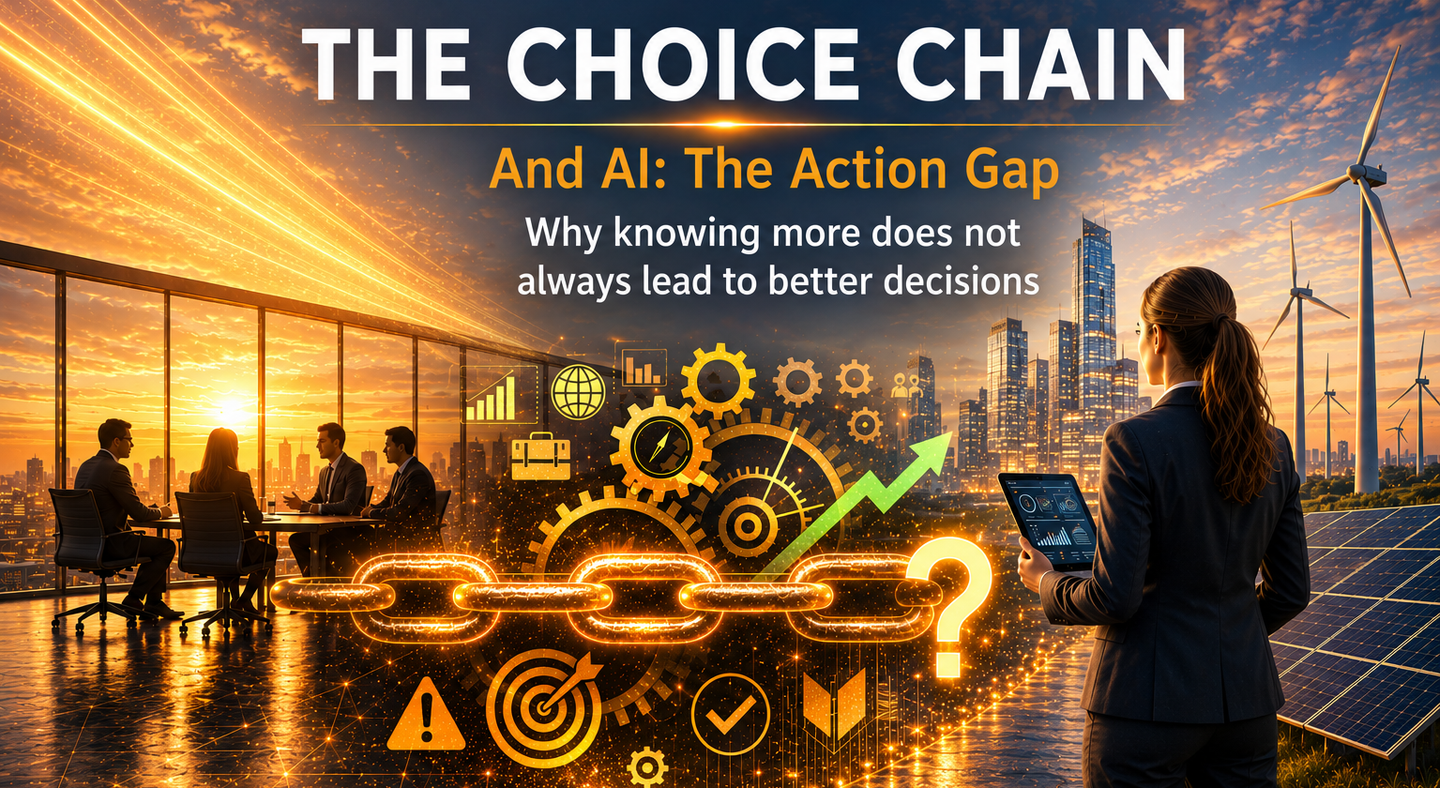
The Choice Chain and AI: The Action Gap
AI closes the Knowing Gap. The Action Gap is still ours.
Artificial Intelligence is rapidly becoming one of the most discussed topics in business, governance and society.
AI can analyse vast amounts of information, identify patterns, generate reports and support decision-making at a speed that would have been unimaginable only a few years ago.
The potential is extraordinary.
Here in Cambridge, where science and innovation are part of everyday life, conversations are increasingly moving beyond automation and towards discovery. AI is helping scientists understand complex biological systems, accelerate drug discovery and uncover relationships that would previously have taken years to identify. Our ability to understand the world is expanding at extraordinary speed. The question is whether our ability to govern the consequences is keeping pace.
This reflects a broader pattern. Throughout history, human capability has often expanded faster than our ability to understand and govern the consequences. Artificial Intelligence may be the latest example.
Yet beneath the excitement lies a question that receives far less attention:
If organisations are about to know more than ever before, why do they still struggle to act on what matters most?
This is what I have come to think of as the Action Gap.
Most organisations do not suffer from a lack of information.
They have dashboards, reports, audits, risk assessments, assurance processes and performance measures. Increasingly, they also have AI-generated insights, forecasts and recommendations.
The challenge isn't about not seeing the issue.
The challenge is deciding what to do about it.
I had an interesting conversation with Kate Field recently. She clearly articulated how organisations move to make the easy improvements first. Medium-term improvements are often planned. Yet the most difficult choices — those that could fundamentally improve long-term resilience and performance — are frequently deferred. The reality is organisations often understand the long-term choices required, yet short-term pressures make these incredibly challenging to prioritise.
Research backs up her observations. Research from McKinsey, FCLTGlobal, KPMG and the Institute of Directors consistently finds that organisations that maintain long-term decision horizons outperform those focused on short-term optimisation, yet decision makers still feel pressured to prioritise near-term results.
The issue is rarely information alone. The gap often lies between awareness and action.
And this is where AI becomes particularly interesting.
It got me thinking about vapes. When vapes first emerged, much of the discussion focused on whether they were safer than cigarettes. A reasonable and important question.
But imagine being able to prompt a powerful AI system:
"What conditions could widespread adoption create over the next decade?"
It might have highlighted potential benefits, such as smoking cessation, while also identifying possible unintended consequences: increased youth uptake, the normalisation of nicotine use, environmental waste, battery disposal issues, fire risks, long-term uncertainty about health impacts.
Not because AI can predict the future, but because it can connect knowledge across multiple domains and help us think more systematically about possible outcomes. These are issues that those of us working across Environmental Health, Safety and Public Health may reasonably have assessed too.
This is where AI may be genuinely transformative. It can help reduce what I would call the Knowing Gap. It can help us see relationships, risks and consequences that may previously have remained hidden.
The same AI capabilities helping scientists uncover hidden biological relationships could also help organisations understand how decisions, behaviours and conditions combine to create future risks.
There is a second question.
If those possibilities had been identified earlier, would we necessarily have acted differently?
Some would still have prioritised smoking reduction. Others would have argued for stronger controls. Others may have called for further evidence.
These are not information problems. They are trade-off problems. They are judgement problems. And ultimately they are governance problems.
The same challenge appears in climate change, public health, safety and organisational leadership.
The challenge is rarely choosing between good and bad options. More often, leaders are navigating trade-offs between competing priorities, vocal stakeholders, commercial pressures and uncertain consequences. AI may help us understand those trade-offs more clearly, but it cannot remove them.
This is why I think the most important contribution AI makes is not that it helps us optimise decisions.
It is that it helps us understand the consequences and trade-offs of our choices more clearly.
Optimisation simply means achieving a chosen objective as efficiently as possible.
But every optimisation starts with a question:
Optimise for what? Profit? Growth? Productivity? Safety? Innovation? Wellbeing? Resilience?
The answer matters because AI can help optimise a goal, but it cannot determine which goals deserve priority.
Those remain questions of values, ethics, governance and human judgement.
This is particularly important because AI is becoming a new translator within organisational decision-making.
It gathers information. It filters information. It prioritises information. It recommends actions.
In doing so, it influences what leaders see, what receives attention and which signals carry weight.
The promise is greater visibility.
The risk is that we become increasingly dependent on the signals AI can see, while overlooking those that are harder to measure.
This takes us back to a theme I explored in an earlier Choice Chain article: signal equity.
Not all signals carry equal weight. Some are amplified. Others remain whispers.
Good governance is not simply about receiving more information.
It is about ensuring that important signals are not lost, however they arrive.
Perhaps the greatest risk associated with AI is not that it replaces human decision-making.
It is that humans gradually lose confidence in exercising judgement when certainty is unavailable.
This is a pattern many of us may recognise. Difficult decisions delayed are not delayed because information is unavailable. Decisions are delayed because those making the decision remain uncertain. Governance capability is not about achieving certainty. It is about developing the confidence to make decisions despite it.
Therefore, the challenge facing organisations may no longer be generating information. It may be creating conditions for good judgement.
As AI becomes part of the Choice Chain, leaders should ask not only: what is the system telling us? But also: what are we prepared to do differently because of it?
Artificial Intelligence is clearly helping us reduce the Knowing Gap. The greater challenge may be whether we can close the Action Gap. And that depends not on technology, but on our willingness to make difficult choices in the face of uncertainty.
If this resonates with you, particularly if you are operating at Board or Executive level, I’d welcome the conversation. How are decisions really being made in your organisation?
Start the conversation