
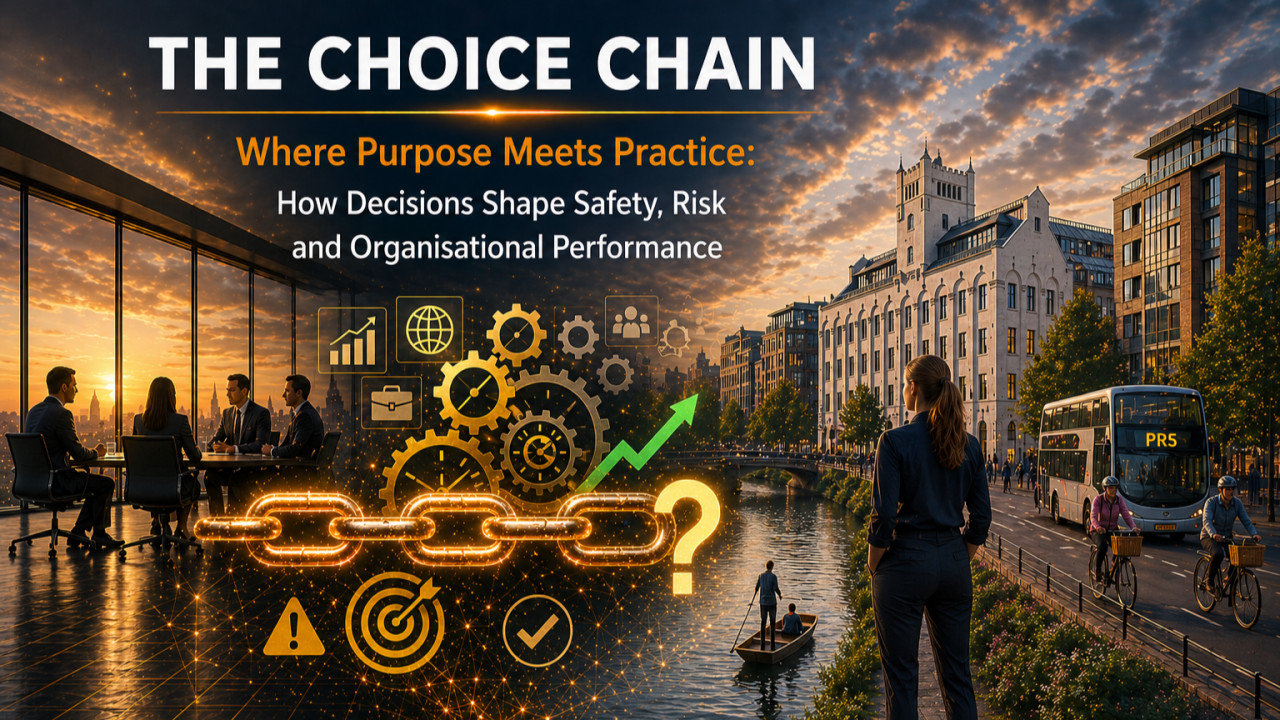
Why Purpose Is About Decisions, Not Statements
Purpose isn't tested when things are easy.
In earlier reflections on the Choice Chain, I explored how organisational outcomes are shaped not by isolated actions, but by sequences of interconnected decisions.
I also reflected on how the signals that inform those decisions do not carry equal weight. Some are immediate, measurable and visible. Others — often those linked to human experience — are weaker, slower to emerge and easier to overlook.
Together, these ideas raise a more practical question.
If decisions shape outcomes, and signals shape decisions, what are organisational decisions actually setting in motion?
I returned to Cambridge a couple of years ago and now live just a mile from where I was born. After University, I briefly returned here as an Environmental Health Officer for the City Council.
Walking through the beautiful and historic streets of this globally recognised centre of innovation and economic success, the contrasts in how people live and work are not always immediately obvious. The UK Government has identified Cambridge as a key location for investment to boost national productivity. Yet, early in my career, I saw first-hand the differences in how people live here — and it remains a city where significant differences in living conditions exist within a relatively small area — a pattern increasingly recognised in discussions about housing and inequality. It is also one of the most water-stressed areas, with high growth plans placing pressure on critical chalk streams. These are not separate issues — economic growth, environmental constraint, social inequality.
These issues are interconnected, shaped by the choices being made for and across the city.
Choices about development, infrastructure, employment, housing and resource use — each rational in isolation — together shape the conditions in which people live and work. These decisions reflect the ambition to drive growth and opportunity, while also creating new pressures that need to be managed — placing Cambridge within a broader conversation about how competing priorities are balanced. While Cambridge provides a visible example, these patterns are not unique to one place.
Organisations operate within these same systems. Their choices do not remain within organisational boundaries. They have consequences "beyond the factory gates", shaping whole communities — locally, nationally and internationally — and those communities form the workforce, customer base and operating environment that organisations depend upon.
This is where Environmental Health provides a useful lens.
Environmental Health brings together the factors that most directly influence how people live and work — including food, housing, workplaces, public health, communities and the environment — and shows how these are shaped by organisational choices. In doing so, it makes visible the link between those choices, human health and organisational performance.
Viewed in this way, a consistent pattern emerges.
Choices create exposure and outcomes (positive and negative).
Exposures shape health.
Health influences organisational performance.
In other words, without a healthy population we cannot have economic success — and this is the choice chain in practice.
Consider how work is designed. Choices about workload, accountability, pace and autonomy shape levels of stress and mental wellbeing. Work-related stress does not remain in work — it affects families and wider communities. Over time, it influences not only absence and retention, but the quality of decisions being made across an organisation.
Or, consider operational choices that influence environmental conditions — such as emissions affecting air quality or discharges affecting water systems. Air pollution is well established as a contributor to long-term health outcomes, including impacts on respiratory and cardiovascular health, as well as emerging evidence relating to pregnancy outcomes. These impacts are often greater in lower socio-economic groups. These same communities are part of the workforce and customer base organisations depend upon. The effects may not be immediately visible, but they return through productivity, resilience, reputational risk and long-term demand.
Housing and living conditions follow similar patterns. Choices about fair pay, decent, safe work, location and investment influence how people live. In turn, this shapes health, stability and the capacity to work and contribute — pressures that are increasingly being discussed within Cambridge.
These are not external issues.
They are the consequences of choices made by decision makers — and increasingly return as performance, risk and cost across people, society, the environment and the economy. Over time, these effects accumulate — shaping not only organisational performance, but the resilience of the systems organisations depend upon.
These choices share common characteristics. Their impacts are delayed, distributed and often difficult to quantify at the point decisions are made. As a result, they struggle to compete with more immediate signals, particularly in relation to short-term financial pressures.
Financial performance remains important — and rightly so. Without it, organisations cannot operate, invest or grow. But financial success is often a proxy for something deeper — security, stability and the very ability to make choices. For individuals, this is about living well. For organisations, it is about maintaining the conditions to operate and grow.
In conditions of uncertainty, it is natural for decisions to prioritise what is most visible and measurable. Financial signals carry urgency and clarity, and so they dominate.
This is not a failure of intent. It is how systems behave and it is why those working across Environmental Health, Safety, Wellbeing and Governance are increasingly required to consider the systems shaping those decisions.
It also explains why purpose can become difficult to translate into practice.
Organisations can be clear about what they stand for, yet still make decisions that don't reflect it. Purpose is not tested when things are easy. It becomes visible in the choices organisations make — particularly when there are trade-offs between short-term performance and longer-term consequences. Being purpose-driven is not about adding new initiatives. It is about how choices are made in reality.
For leaders, this does not mean stepping away from financial discipline. In a volatile environment, maintaining financial stability remains essential. The shift is more subtle.
It is to recognise that every decision changes something — how work feels, how people respond and what pressures exist — and over time, that is what shapes performance, as well as community wellbeing and cohesion, which in turn influence workforce stability and long-term demand.
This begins by asking a different question.
Not only: what will this decision deliver?
But also: what will this decision create?
For the people who work within the organisation, for the communities it depends upon, and for the system it operates within.
Organisations that begin to see these connections more clearly are better able to anticipate risk, strengthen capability and sustain performance over the longer-term — enabling a shift from reacting to issues toward anticipating and shaping outcomes for a sustainable growth.
This also requires space for reflection. Where leaders are operating under constant pressure, decision-making can become fragmented and reactive. Creating the capacity to step back and see these connections is a critical leadership capability.
And that is where purpose becomes real.
Not in what organisations say they stand for.
But in the choices they make — every day — and the conditions those choices create over time.
Because what we choose to prioritise today becomes the conditions we live and work within tomorrow — shaping how we live, how we work, and how we thrive.
If this resonates with you, particularly if you are operating at Board or Executive level, I’d welcome the conversation. How are decisions really being made in your organisation?
Start the conversation