
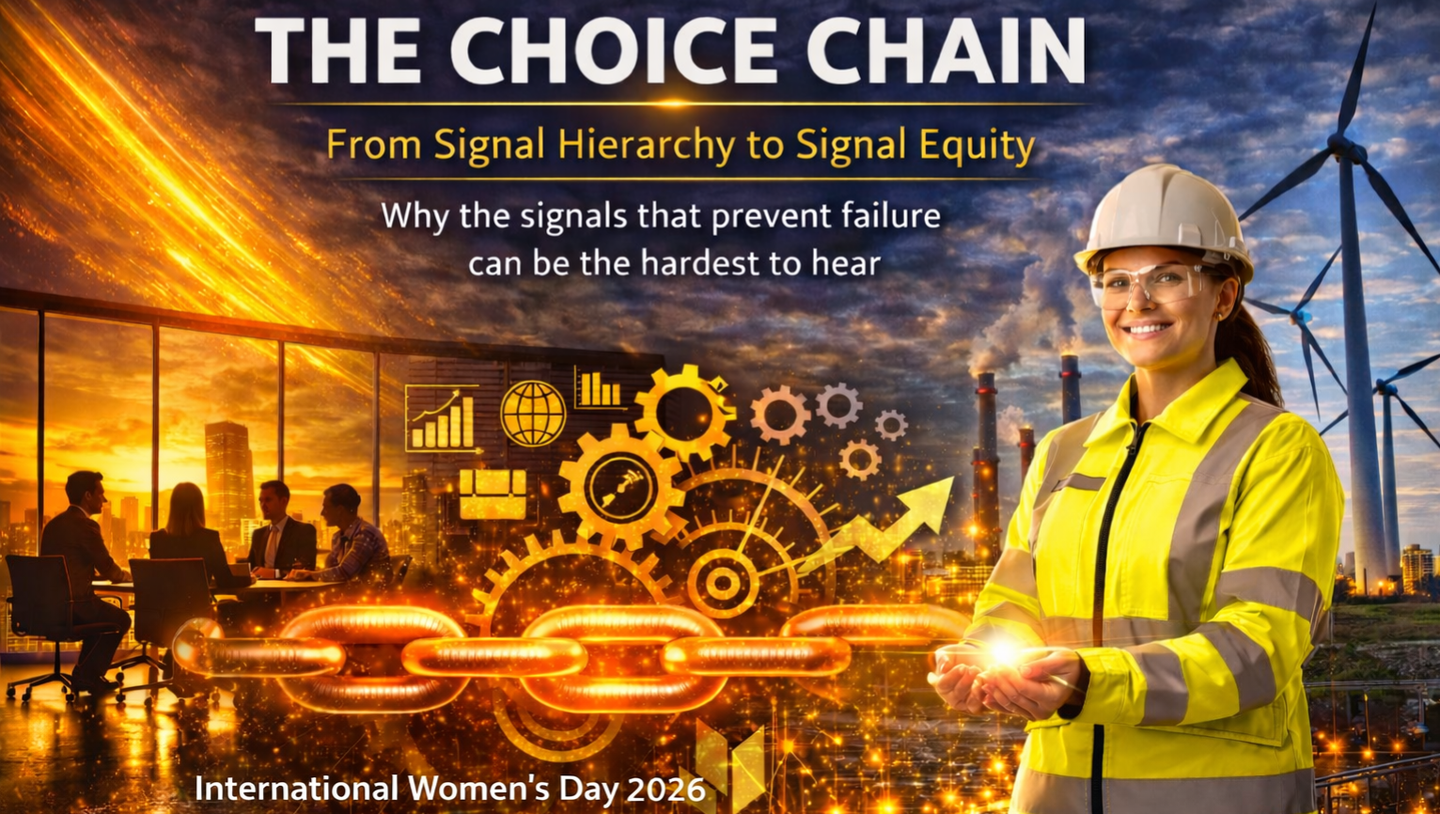
From Signal Hierarchy to Signal Equity
Why the signals that prevent failure are hardest to hear.
International Women's Day 2026 theme is "Give to Gain" — when we give opportunity, voice and influence to women, everyone benefits, we raise the tide for everyone.
Many conversations about inclusion focus on representation. Who is in the room matters. But diversity may matter for another reason particularly relevant to leaders responsible for governance and risk.
Diverse perspectives strengthen an organisation's ability to detect weak signals before they become crises.
That idea becomes clearer when we consider a simple question:
Which signals never make it to the decision table at all, and why?
Governance depends on signals — warnings, observations and emerging indicators that help leaders understand risk and performance.
Financial indicators, operational data, performance metrics, risk reports and stakeholder insight all shape how leaders understand risk and performance.
But signals do not travel equally.
Most organisations operate with an implicit signal hierarchy.
Signals linked to financial capital tend to carry the greatest authority — revenue pressures, cost overruns, regulatory exposure, legal risk. These signals appear objective and data driven so they are prioritised. These signals move quickly through governance systems because they are quantified, standardised and embedded in reporting structures.
Signals linked to human experience may travel differently.
A worker sensing something is unsafe. An employee noticing a shift in culture. A community raising concerns about impact. A patient describing symptoms before diagnostic evidence appears.
These signals are often qualitative, contextual and harder to measure. As a result, they can struggle to compete with more formal indicators of performance.
Signal translation through the Choice Chain
Signals rarely move through organisations unchanged. As they travel through the Choice Chain — from frontline to management, from management to executive, from executive to board — they are interpreted and reframed.
A frontline observation might begin as:
"Something about this situation doesn't feel safe."
By the time the signal reaches the executive level it may sound more like:
"We've had a few operational issues, but risk remains within tolerance."
The signal still exists, but its urgency has faded.
Translation is not necessarily intentional. It often reflects the natural way organisations convert operational insight into strategic language. But the effect can be significant: early warnings become softened, reframed or delayed.
Weak signals and missed opportunities
Research across safety science, organisational psychology and systems thinking shows that major failures rarely occur without warning.
Early indicators often appear as weak signals — subtle anomalies, frontline concerns or lived experiences suggesting something may be changing.
Weak signals are easy to dismiss because they are incomplete, ambiguous and difficult to quantify. Yet they frequently provide the earliest opportunity to prevent failure.
Environmental Health and Safety professionals understand this well. Events and incidents are often preceded by warnings that, in hindsight, appear obvious. The challenge was not that signals were absent — it was that they struggled to gain authority within the organisation.
The implications of signal hierarchy become even clearer when we consider gender and whose signals carry authority.
The gender data gap
Caroline Criado Perez's book Invisible Women: Exposing Data Bias in a World Designed for Men highlights another dimension of this issue: the gender data gap.
Across many areas of society — from medicine to product design — systems have historically been built using male data as the default, based on male bodies, male behaviours and male working patterns. When data excludes women's experiences, the decisions built on that data can unintentionally disadvantage them.
But the challenge goes beyond data.
Even when signals are present, the authority given to those signals may differ depending on how they are expressed and interpreted.
Research increasingly shows that women's voices can also carry less weight in decision environments, particularly when signals are qualitative, experiential or expressed through collaborative communication styles.
Studies in organisational behaviour and collective intelligence have found that teams with greater gender diversity tend to perform better at complex problem-solving partly because of higher levels of social sensitivity and more balanced communication patterns (Woolley et al., 2010). This suggests that diverse groups may be better at detecting subtle or emerging risks.
Yet many leadership environments still prioritise signals that appear most objective: financial metrics, quantitative data or regulatory indicators. Signals grounded in lived experience — such as early health symptoms, cultural discomfort, or frontline safety concerns — can struggle to compete for attention.
Healthcare provides a powerful illustration of this challenge. The UK Government's Women's Health Strategy for England (2022), based on a large national call for evidence, found that many women reported not feeling listened to or believed when raising health concerns. Symptoms were sometimes normalised or dismissed before clinical evidence emerged.
I contributed to this research and, like many women, I have experienced a situation where something felt wrong long before the system recognised it. When my concern was eventually taken seriously, it required emergency surgery. Experiences like this, reinforced by the national research, have made me reflect on how decision systems interpret human signals.
Research has shown women's pain is more likely to be underestimated by clinicians and women wait longer for diagnoses for conditions such as endometriosis.
The signal existed — but it lacked authority.
The system did not recognise its significance.
The gender data gap therefore highlights two related challenges:
First, the absence of women's experiences in the data used to shape decisions.
Second, the possibility that even when women raise signals, those signals may carry less authority within decision systems.
Both issues reinforce the importance of moving from signal hierarchy to signal equity — ensuring that signals linked to human experience have the opportunity to influence governance decisions alongside more traditional financial indicators.
Weak signals in a complex world
The importance of recognising weak signals becomes even clearer when we consider the broader global context.
Many of today's biggest risks — climate change, geopolitical instability, societal fragmentation — rarely emerge first as financial indicators. They appear earlier as human, environmental or social signals.
Changes in behaviour. Patterns of concern. Operational anomalies.
If organisations rely only on strong signals that appear later in financial or regulatory metrics, the opportunity to act early may already have passed. The result is that organisations remain reactive rather than proactive — a model that is increasingly unsustainable.
From signal hierarchy to signal equity
This raises an important governance challenge.
If organisations rely on signals to make decisions, how confident are we that the signals shaping those decisions are the ones that matter most?
Modern governance may require a shift — from signal hierarchy to signal equity.
Signal equity means ensuring that signals linked to all forms of capital have the opportunity to influence decisions. This includes signals connected to financial performance, human wellbeing, social legitimacy and environmental impact.
Signal equity does not mean every signal carries equal weight.
It means signals are evaluated based on their relevance to risk and impact — not simply on their format or perceived authority.
Give to Gain
This is where the International Women's Day theme Give to Gain becomes particularly meaningful.
When organisations give voice and influence to a wider range of perspectives, they gain access to signals that might otherwise remain unheard.
Different experiences can highlight emerging risks, unintended consequences and operational realities that traditional decision systems overlook.
Diverse leadership does not simply change who is in the room.
It changes which signals shape the decisions being made.
The question for leaders
For leaders responsible for governance and risk, the challenge may not be the absence of signals.
It may be whether those signals retain their strength as they travel through the organisation.
Because in complex systems, an uncomfortable possibility remains:
What if the signals most likely to prevent failure are the ones least likely to carry authority inside organisations?
And perhaps the most important question of all:
Which signals never make it to the decision table at all?
Organisations do not fail because signals are absent. They fail because signals weaken as they travel through the choice chain.
If this resonates with you, particularly if you are operating at Board or Executive level, I’d welcome the conversation. How are decisions really being made in your organisation?
Start the conversation