
Are Decisions, Not Activity, Driving Health & Safety Performance?
Effort is rising. Outcomes are flat. Why?
Across sectors, activity is increasing. More oversight. More systems. More reporting. More focus. More resource. And yet outcomes in many organisations remain stubbornly flat.
When effort rises but performance does not shift, we need to ask a harder question: Are decisions — not activity — shaping performance?
From Compassion to Governance
During my time as IOSH President, I spoke about putting the heart back into health and safety — about compassion, focusing on people and human capital. I remain deeply committed to that belief.
Organisations only thrive long term when they genuinely look after those inside them. When people are trusted and their wellbeing is a strategic priority, they will use innovation to navigate the challenges we are currently facing.
But reflection over recent years has sharpened something else for me: care and culture alone cannot change outcomes if governance, incentives and decision pathways do not allow them to.
When Effort Isn't the Issue
In complex organisations facing financial pressure, geopolitical instability and constant change, Environmental Health, Safety and Wellbeing rarely competes with indifference. It competes with liquidity, investor confidence, regulatory exposure and operational continuity.
Leaders are often not asking, "Is this important?" They are asking, "What will this trigger? What are we exposing ourselves to?"
When risk messaging implies structural weakness, delay or financial shock, it can activate what behavioural science describes as continuation bias — the tendency to persist with an existing course of action even when signals suggest adaptation may be needed.
This is not incompetence. It is human decision-making under pressure.
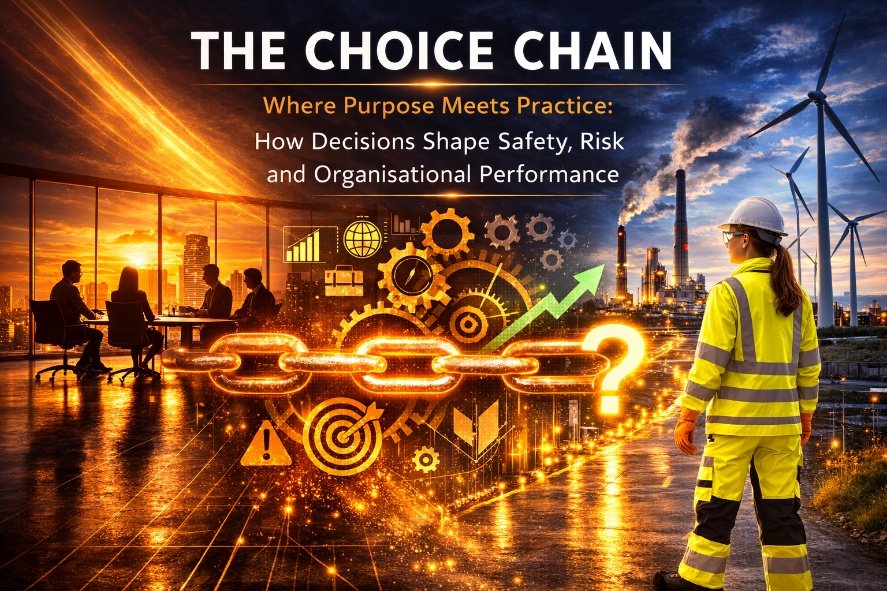
The Choice Chain
Through my work alongside governance professionals and within leadership roles, I have come to describe this pattern as the Choice Chain — how organisational outcomes are shaped by a sequence of interconnected decisions made across governance levels.
Major failures are rarely single reckless acts. They are the accumulation of rational decisions made within existing incentives, structures and reporting cycles.
Boards set organisational purpose and define risk appetite. Executives translate that into strategy, resource allocation and performance incentives. Managers operationalise targets and deliverables. Frontline teams ultimately ask a simple question: 'Is this safe for me?'
If signals weaken over time as they move through the Choice Chain, that is data. It is not about leaders not caring. It tells us something about how our decision pathways are functioning and where alignment may be needed.
Translation Matters
The challenge for us as Environmental Health, Safety and Wellbeing professionals is whether our messages are landing at the altitude where decisions are actually being made.
When human harm is translated as human capital risk, when fatalities are understood as reputational and financial shock, when environmental failure is recognised as natural capital depletion, the conversation shifts from compliance to long-term value protection.
The question is not whether safety matters. It is whether we are framing it in a way that aligns with how strategic decisions are evaluated.
Why This Matters Now
The World Economic Forum's Global Risks Report (2026) highlights geopolitical instability, misinformation and societal polarisation among the most significant systemic threats.
In this environment, governance fragility is amplified. Trust is harder to sustain, and decision-makers face unprecedented trade-offs.
Global governance standards — from ISO 37000 to OECD principles and emerging climate disclosure frameworks — increasingly reinforce the need to protect long-term value across financial, human, social and natural capital.
The challenge is not awareness. It is alignment.
One Conversation at a Time — and What Follows
I have always believed that change happens one conversation at a time.
But I am increasingly convinced that the future of Environmental Health, Safety and Wellbeing depends on what organisations decide after our conversations — when we leave the room, when competing priorities collide and leadership psychology is activated.
Performance does not change because conversations happen. It changes because decisions do. Culture does not override structure. Structure shapes behaviour.
If your health & safety performance has plateaued, don't start by asking how much activity is taking place.
Ask how decisions are being made. Ask what leaders feel they must protect. Ask where signals weaken as they move through the organisation.
That is where transformation truly sits.
If this resonates with you, particularly if you are operating at Board or Executive level, I’d welcome the conversation. How are decisions really being made in your organisation?
Start the conversation